
Implied Volatility Explained: How It Affects Options Premiums
Have you ever looked at an option and wondered why its price changed when the stock barely moved?
That can be one of the most confusing parts of options trading for newer investors.
You might correctly anticipate that a stock will stay relatively stable, yet the option premium changes more than expected. Or you might see an option become much more expensive before an earnings announcement even though the stock itself hasn't made a dramatic move.
What's going on?
One important piece of the puzzle is implied volatility, or IV.
What Is Implied Volatility?
Implied volatility is the market's expectation of how much an underlying stock could move in the future.
The important word here is expectation.
IV doesn't tell you whether the stock is expected to go up or down. Instead, it reflects expectations about the potential magnitude of future movement.
Think about it this way.
If a stock is expected to remain relatively quiet, options may be priced with lower volatility expectations.
If the market expects a large move because of an upcoming earnings announcement, economic event, or other catalyst, options may carry higher volatility expectations.
That difference can affect the premium investors pay for the option.
And this leads to one of the biggest misconceptions about options pricing.

The Stock Price Isn't the Whole Story
A common assumption is:
"If the stock doesn't move much, the option shouldn't move much either."
That's not necessarily true.
An option's premium is influenced by several factors, including the underlying stock price, time remaining until expiration, and implied volatility.
This is why an option can sometimes become more expensive even when the stock itself hasn't moved significantly.
For newer traders, it's easy to focus almost entirely on direction:
Will the stock go up or down?
But options require another question:
What does the market expect the stock to do?
That distinction matters.
A Simple Earnings Example
Imagine a stock trading around $100.
The company is scheduled to report earnings next week.
The stock hasn't moved dramatically. But earnings create uncertainty because the market doesn't know whether the company will beat expectations, miss expectations, raise guidance, or surprise investors in some other way.
As that event approaches, implied volatility may increase.
That can make the options more expensive because the market is pricing in greater potential movement.
Now suppose earnings are released.
The stock moves only 2%.
That might seem like a relatively modest move.
But the uncertainty surrounding the earnings announcement is now gone. As a result, implied volatility can fall.
So even though the stock didn't make a huge move, the option premium can change because the market's expectations about future volatility changed.
This is sometimes referred to as IV contraction or a decline in implied volatility after an anticipated event.
The lesson isn't that IV always rises before earnings or always falls afterward. The important idea is that changes in volatility expectations can affect option premiums independently of the stock's direction.
Why Investors Miss This
The problem usually isn't a lack of intelligence.
It's that stock investing trains us to think primarily about direction.
Buy a stock because you believe it will rise.
Sell it because you believe it will fall.
Options add another layer.
Now you have to think about direction, timing, and expectations for movement.
That extra layer can make an option appear to behave strangely if you're only watching the stock price.
That's why I like to keep the concept simple rather than trying to memorize every component of an options pricing model.
The 3-Question IV Check
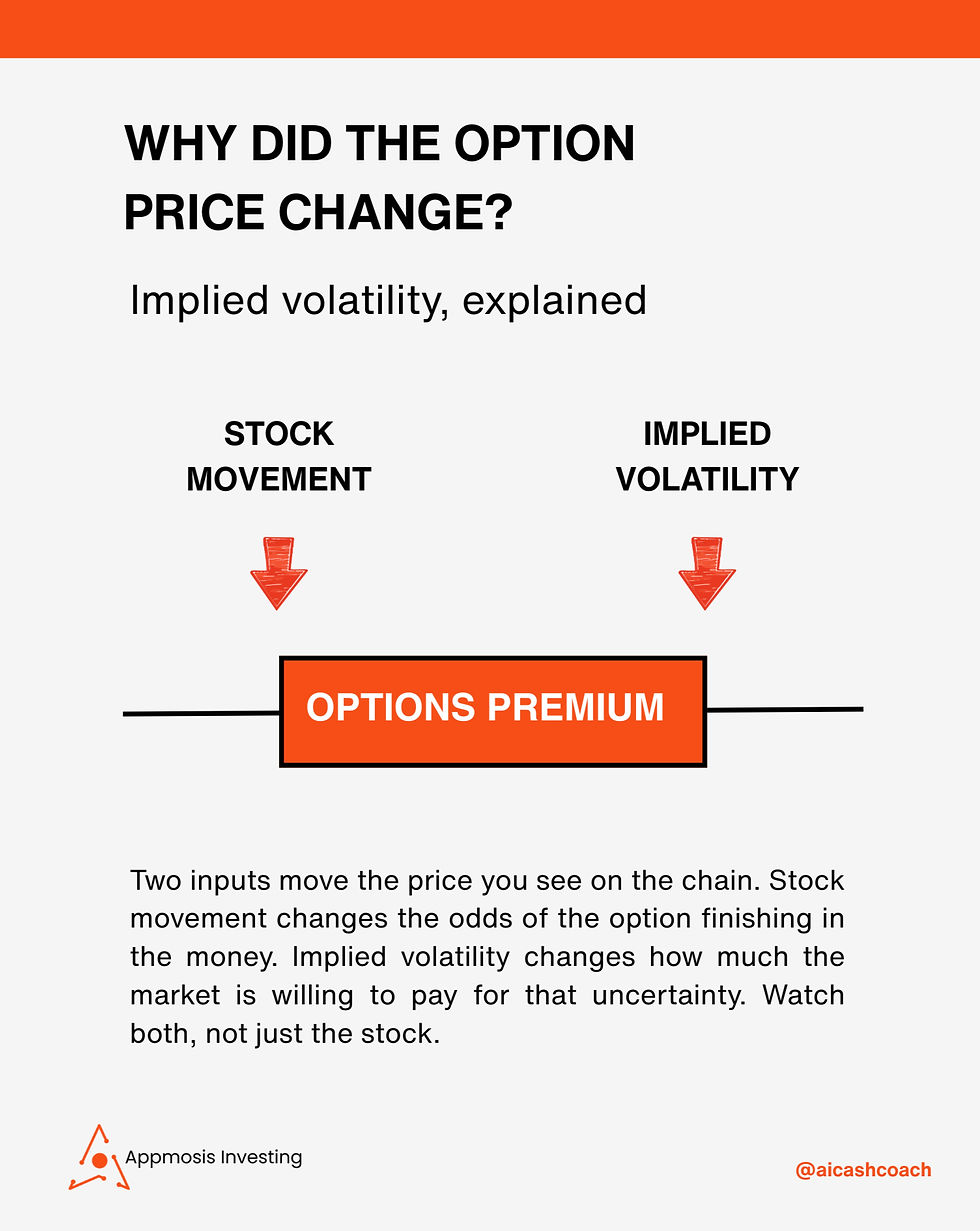
Before evaluating an option, ask three questions.
1. What is the stock doing?
Is it moving sharply, trending gradually, or staying relatively flat?
Start with the underlying.
2. What is implied volatility doing?
Is IV rising, falling, or relatively stable?
This gives you context about how the market's expectations are changing.
3. How could that affect the premium?
If volatility expectations change, the option premium may change too.
This doesn't tell you whether a trade is good or bad.
It simply helps you understand what's happening.
That's the key.
IV shouldn't be treated as a magic buy or sell signal. It's another piece of information that can help you understand the price you're seeing.
High IV Isn't Automatically Bad
Another misconception is that high IV is always bad and low IV is always good.
It's not that simple.
Higher implied volatility can mean options are carrying larger premiums because the market expects greater potential movement.
Lower IV can mean lower volatility expectations and potentially lower premiums.
But whether that is favorable depends on what you're trying to do, the strategy you're using, the expiration, the strike, the underlying, and the risks involved.
The goal isn't to label IV as "good" or "bad."
The goal is to understand it.
The Mindset Shift
When evaluating an option, don't just ask:
"Where do I think the stock is going?"
Also ask:
"What does the market expect the stock to do?"
That small shift can make options pricing much easier to understand.
The next time an option premium seems to move in a way that doesn't make sense, go back to the basics:
Look at the stock.
Look at the time remaining.
Then look at implied volatility.
The stock's movement is important—but it isn't the whole story.
Ready to Go Beyond the Basics?
Understanding implied volatility is one piece of becoming more comfortable with options.
If you want to learn how options strategies work and how to think through trades more systematically, explore EZOptions.
Learn the fundamentals. Understand the strategy. Then put the pieces together.
Want Another Way to Learn?
Keep building your options knowledge at your own pace with Appmosis's educational resources.
Explore the available investing books and guides for another practical way to strengthen your options foundation.


Comments