
Premium Income Isn't Free: What You're Giving Up When You Sell Options
Selling options can be an attractive strategy because you receive premium upfront.
That part is easy to see.
What's easier to miss is what you're giving up in exchange for that premium.
When you sell an option, you're not simply collecting money. You're accepting an obligation, limiting some possibilities, or committing capital for a period of time.
That's why I think it's important to look beyond the premium itself.
The better question isn't:
"How much premium can I collect?"
It's:
"What am I giving up to collect it?"
The Misconception: Premium Is Free Money
One of the most common mistakes I see when investors first learn about selling options is
focusing almost entirely on the cash received.
For example:
You sell an option for $2.00.
You receive $200 on a standard 100-share contract.
It can be tempting to think of that $200 as income that came with no real cost.
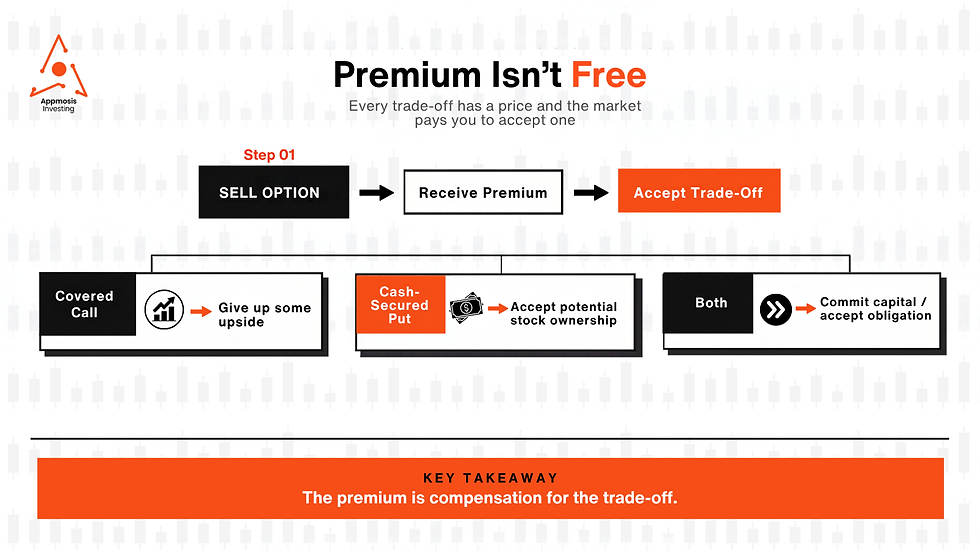
But the premium exists because you accepted something in return.
With a covered call, you accept the possibility of selling your shares at the strike price, which limits your upside while the call is open.
With a cash-secured put, you accept the possibility of buying shares at the strike price if assigned.
The premium compensates you for taking on that obligation.
That's a very different way of looking at the trade.
What You're Giving Up With a Covered Call
Suppose you own 100 shares of a stock trading at $100.
You sell a $110 covered call and receive a $2 premium, or $200.
If the stock stays below $110 through expiration, you may keep the shares and the premium, assuming the option isn't otherwise assigned.
But what happens if the stock jumps to $125?
Your covered call doesn't participate in all of that upside.
If the shares are assigned, you're obligated to sell them at the $110 strike, subject to the terms of the option and the assignment process.
You received the $2 premium.
But you gave up additional upside above the strike.
That's not necessarily a bad trade.
If you were genuinely comfortable selling the stock at $110, the outcome may have matched your plan.
The point is simply that the premium wasn't free.
You exchanged some upside potential for the premium.
Covered-call education from the Options Industry Council makes the same basic trade-off clear: the strategy can generate premium, but the investor forfeits some of the stock's upside while the short call remains open.
What You're Giving Up With a Cash-Secured Put
The trade-off looks different with a cash-secured put.
Imagine a stock is trading at $100.
You sell a $90 put and receive a $2 premium.
In exchange, you accept the possibility of buying 100 shares at $90 if you're assigned.
If the stock stays above $90, you may simply keep the premium.
But suppose the stock falls to $70.
The $2 premium doesn't eliminate the loss associated with owning the stock at a $90 strike if assignment occurs.
Your effective purchase price would be reduced by the premium, but you would still be exposed to the stock's decline.
There is another opportunity cost, too.
If the stock rises from $100 to $130 without ever falling to your strike, you may keep the premium—but you didn't participate in that stock ownership because you never acquired the shares.
The Options Industry Council describes a cash-secured put primarily as a stock-acquisition strategy for an investor willing to own the underlying, while also highlighting the substantial downside risk if the stock falls significantly.
Premium Is Compensation for a Trade-Off
This is the framework I like to use when evaluating premium-selling strategies:
1. What am I receiving?
Start with the obvious number.
How much premium are you collecting?
2. What am I agreeing to?
A short option creates an obligation.
For a covered call, you may have to sell your shares at the strike.
For a cash-secured put, you may have to buy shares at the strike.
Make sure you're comfortable with that outcome before entering the trade.
3. What am I giving up?
This is the question investors often skip.
Are you giving up some upside?
Are you tying up cash?
Are you limiting your flexibility?
Could you miss an opportunity elsewhere?
4. What happens if the stock moves sharply?
Don't only consider the outcome you want.
Consider the scenario that would make you uncomfortable.
A good trade isn't one where everything has to go exactly as planned.
5. Would I still want the trade without the premium?
This is my favorite question.
If the answer is no, the premium may be influencing your decision too much.
A Simple Example

Let's say Maya owns 100 shares of a company at $100.
She's considering selling a $110 covered call for $2.
The $200 premium looks attractive.
But before entering the trade, she asks:
Would I be happy selling these shares at $110?
If the answer is yes, the covered call may fit her objective.
If the answer is no—because she believes the stock could rise substantially and she really wants to keep the shares—then the $200 premium may not be enough compensation for what she is giving up.
That's the important distinction.
The question isn't whether $200 is good or bad.
The question is whether $200 is enough compensation for the trade-off she's accepting.
The Bigger Picture
This is why I don't think premium should be the first thing investors look at when evaluating a short option.
Premium is only one part of the trade.
The strike matters.
The expiration matters.
The underlying stock matters.
Your willingness to own or sell the shares matters.
And the opportunity cost matters.
A higher premium can sometimes reflect greater uncertainty or risk. It doesn't automatically mean you've found a better opportunity.
The goal isn't to maximize premium.
The goal is to make sure the premium is appropriate for the trade you're willing to make.
The Mindset Shift
Selling options isn't about collecting "free money."
It's about being compensated for accepting a particular set of trade-offs.
Sometimes that trade-off can make sense.
If you already own a stock and would be comfortable selling it at a particular price, a covered call can align with that objective.
If you have cash and genuinely want to buy a stock at a lower price, a cash-secured put can align with that objective.
But the strategy should come from the decision you are already willing to make—not from the size of the premium.
Before selling an option, I would ask one simple question:
"What am I giving up to receive this premium?"
If you understand that answer, you're evaluating the entire trade—not just the cash that appears in your account.
Want to go beyond collecting premium and learn how to evaluate the entire trade?
EZOptions walks through options strategies, trade setup, risk, and practical decision-making in a hands-on format.
Keep learning: Explore the Appmosis options eBook for practical explanations of options strategies and trade management.


Comments