
Vertical Spreads Explained: How Defined Risk Can Change an Options Trade
When you begin learning options, buying a call or put is often one of the first strategies you encounter. Selling options introduces another set of possibilities, but it also introduces risks that need to be understood.
A vertical spread offers a different approach. Instead of buying or selling just one option, you combine two options on the same underlying stock, with the same expiration date but different strike prices.
This structure can help define the potential risk and reward of a trade before you enter it.
But defined risk doesn't mean no risk. To use vertical spreads effectively, you need to understand how the two contracts work together and what you're giving up in exchange for a more limited risk profile.
What Is a Vertical Spread?
A vertical spread is an options strategy that uses two contracts of the same type—both calls or both puts—with the same expiration date and different strike prices.
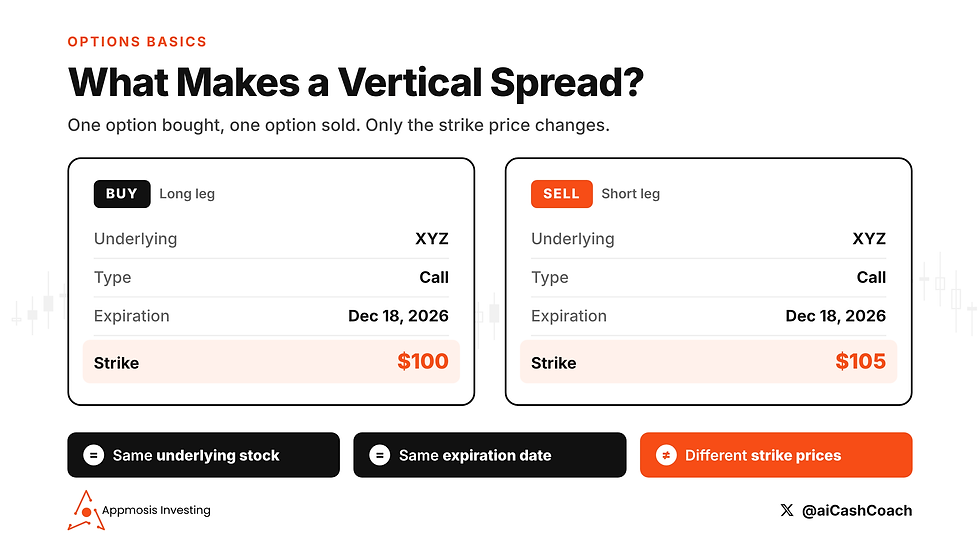
One option is bought and the other is sold.
The combination creates a spread between the two strike prices. That spread determines the position's maximum potential gain and loss, based on the opening debit or credit.
There are two broad ways to structure a vertical spread:
Credit spread: You receive a net credit when opening the position. The goal is generally for the spread to decrease in value or expire without value.
Debit spread: You pay a net debit when opening the position. The goal is generally for the spread to increase in value.
Credit and debit spreads can each be bullish or bearish. The specific combination of calls or puts and which strike is bought or sold determines the trade's direction and payoff.
How a Vertical Spread Defines Risk
The important feature of a vertical spread is that the long option offsets some of the exposure created by the short option.
For example, selling a put on its own can create a substantial obligation if the stock falls.Buying another put at a lower strike creates a floor on the spread's expiration loss.
That doesn't prevent the stock from falling or guarantee a profitable outcome. It changes the structure of the position so the maximum potential loss can be calculated when the spread is opened.
Let's look at a simple example.
A Simple Example: A Bull Put Credit Spread
Imagine a stock is trading at $105.
You believe the stock will remain above $100 through expiration. Rather than selling a $100 put by itself, you decide to use a bull put spread:
Sell one $100 put.
Buy one $95 put.
Both options have the same expiration date.
You receive a net credit of $1.50 per share.
Because one standard options contract generally represents 100 shares, the opening credit is $150 before transaction costs.
Here's how the potential outcome works:
Maximum profit: The credit received.
$1.50 × 100 = $150
Maximum loss: The difference between the strike prices, minus the credit received.
($100 − $95 − $1.50) × 100 = $350
Breakeven at expiration: The short put strike minus the credit received.
$100 − $1.50 = $98.50

If the stock finishes at or above $100 at expiration, both puts expire without value and the position earns its maximum profit of $150.
If the stock finishes between $100 and $95, the short $100 put has intrinsic value while the long $95 put may still expire without value. The spread experiences a partial loss.
If the stock finishes at or below $95, both puts are in the money. The spread reaches its maximum potential loss of $350, excluding transaction costs
The long $95 put is what limits the spread's expiration loss. Without it, the short $100 put would have a different and potentially much larger risk profile.
Credit Spreads vs. Debit Spreads
Not every vertical spread is designed to collect premium.
A credit spread brings in money when the position is opened. A debit spread requires an upfront payment.
The distinction matters because the potential gain and loss are calculated differently.
For a standard $5-wide credit spread that collects $1.50, the maximum potential gain is $150 and the maximum potential loss is $350 per contract.
For a $5-wide debit spread purchased for $1.50, the maximum potential loss is $150 and the maximum potential gain is $350 per contract.
These are simplified expiration calculations before fees and other transaction costs.
Neither structure is automatically better. The appropriate choice depends on the trader's market outlook, risk tolerance, pricing, and trade objectives.
Three Numbers to Know Before Entering a Spread
Before opening a vertical spread, understand three numbers:
1. Maximum potential profit
How much can you make if the position reaches its most favorable expiration outcome?
2. Maximum potential loss
How much can you lose if the position reaches its least favorable expiration outcome?
3. Breakeven
At what underlying stock price does the position break even at expiration?
These numbers provide a clearer picture of the trade than looking at the premium alone.
They also help you compare one spread with another. A larger credit may look attractive, but it may come with a wider spread, a different probability profile, or a greater amount of risk.
Defined Risk Still Requires Trade Management
A vertical spread can make maximum expiration risk easier to calculate, but there are still important considerations.
Assignment risk: Short options can be assigned before expiration. If that happens, you may temporarily hold a stock position or an obligation that needs attention. The long option does not automatically exercise or resolve the short assignment.
Liquidity: Wide bid-ask spreads can make it more expensive to enter or exit a position. The price you receive may differ from the theoretical value.
Expiration risk: A stock near either strike price at expiration can create uncertainty about which options will be exercised or assigned. Managing positions before expiration may help avoid unwanted surprises.
Execution and costs: The net credit or debit matters. Commissions, fees, and the difference between expected and actual execution prices can affect the outcome.
A defined-risk structure is not a substitute for having an entry plan, an exit plan, and an understanding of what happens if the trade moves against you.
A Better Way to Evaluate an Options Trade
Before entering a vertical spread, work through a simple checklist:
Direction: Does the spread match your bullish or bearish outlook?
Structure: Do you understand which option you're buying and which you're selling?
Risk and reward: Have you calculated the maximum potential profit, maximum potential loss, and breakeven?
Management: Do you know how you plan to manage the spread if the stock moves toward either strike or expiration approaches?
The goal is not to find a spread that guarantees a profit. No options strategy can do that.
The goal is to understand the position before committing capital.
Defined Risk Starts With Understanding the Whole Trade
Vertical spreads can be useful tools for traders who want to structure an options position with a known maximum expiration loss.
But the benefit comes from understanding how the two options work together—not simply from seeing the word "defined risk."
Know the direction, understand the strikes, calculate the potential outcomes, and plan how you'll manage the position.
When you understand the entire spread, you can make more informed decisions about whether it belongs in your options trading approach.
Want to Build a Stronger Foundation in Options?
Understanding how options strategies work starts with knowing the structure, risk, and potential outcomes of each trade.
In EZOptions, Gautam teaches practical options concepts and strategies, helping students develop a more thoughtful approach to options trading.
If you'd like to build your understanding beyond individual calls and puts, explore EZOptions: Options Trading for Regular Income.
Keep Learning About Options and Investing
Continue building your knowledge with practical insights on options strategies, risk management, and investing.
Subscribe to the Appmosis newsletter for educational content designed to help you make more informed financial decisions.


Comments